Quick Answer
A useful automation test should tell you whether a new enquiry reaches the right owner, records the right fields and fails visibly. It rarely needs a real customer’s name, email history or payment data. Create a clearly labelled synthetic enquiry, trace it through each permitted step, and check the exception and alert paths before allowing live traffic through the changed route.
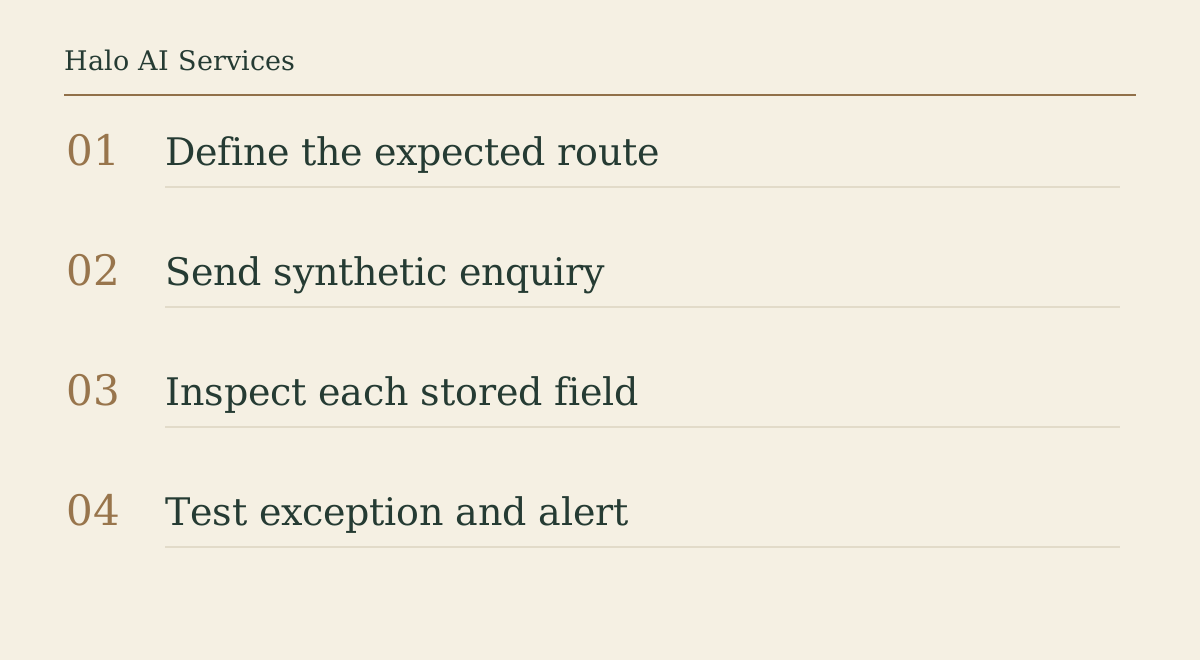
Write the expected result first
List the input fields, consent state, destination record, owner and the point at which a person approves a response. Decide which steps are safe to exercise in a test environment. Do not let a test trigger a customer-facing email, paid ad audience update, invoice or booking. If the workflow cannot suppress those effects, isolate it before testing.
Halo’s enquiry and CRM guides distinguish capture from reviewed follow-up. Use that boundary as your test contract: a created CRM record is not proof that the right person saw and resolved the enquiry.
Create a harmless test record
Use a unique subject such as 'TEST — website enquiry route — 24 Sep' and controlled contact details that belong to the business, where the form accepts them. Avoid copying an actual customer note or using an unrelated person’s address. If a live form is the only available entry point, agree the test window with the route owner and prevent the downstream customer message.
The UK ICO’s data-minimisation guidance supports reviewing what personal information is necessary through development and before go-live. A synthetic record is a practical way to reduce the data exposed during a narrow route test; it is not a claim that every dummy address is safe to send mail to.
Trace storage, timing and ownership
Check the timestamp and local-time rule, destination, duplicate match, assigned owner and visible status. Compare the received fields against the expected contract, including blanks. If the record lands in two places, decide which is authoritative. If a required field vanishes, record the exact step before changing a mapping.
A successful trigger badge is weak evidence. Keep one redacted screenshot or log line per handoff, with secrets and personal data removed, so the next operator can reproduce the result.
Exercise a controlled failure
Test one missing required field or a safe disabled destination in a non-production copy, then check who receives the alert and how the failed record is recovered. Restore the route and run the good-path synthetic enquiry again. Close with the owner, pass/fail evidence and the date of the next test.
If a production route cannot be isolated or the owner of failure recovery is unclear, stop before changing live connections. Halo can scope a bounded audit from the route diagram, redacted test record and desired human approval point.
FAQ
Can I test a CRM route with a real enquiry?
A controlled synthetic record is usually a clearer first test because it reduces exposure and avoids confusing real customer work. Confirm downstream sends are suppressed.
What proves an enquiry automation works?
A trace from input to correct stored record, owner review, alert and recovery, with expected fields checked. A green trigger alone is incomplete.
What if I cannot isolate the workflow?
Document the intended route and obtain owner review before changing live connections or sending test traffic through customer-facing steps.
Next step
Bring Halo one redacted route diagram, a proposed synthetic enquiry and the missing pass/fail evidence. Request a bounded workflow audit before altering live customer messages.
- Request a Halo audit
- Review automation services
- Read the duplicate enquiry check
- Name the failure alert owner
Sources
- ICO data minimisation toolkit: Requires stage-appropriate review of necessary personal information; legal guidance may change.
- Halo data hygiene guide: Brand method for redacted examples and exception queues.