Answer first: When someone asks ChatGPT or Google “how much does a [job] cost in [town]?”, the answer is built from public pages. If yours says nothing about cost, it gives an assistant nothing to quote, and the answer comes from someone else’s page. You do not need to publish a fixed price. Publish one plain, honest cost answer: what the price depends on, a starting figure or range only if you actually charge it, what is and is not included, and how someone gets a real quote. Keep that page, your Google Business Profile and any structured data saying the same thing.
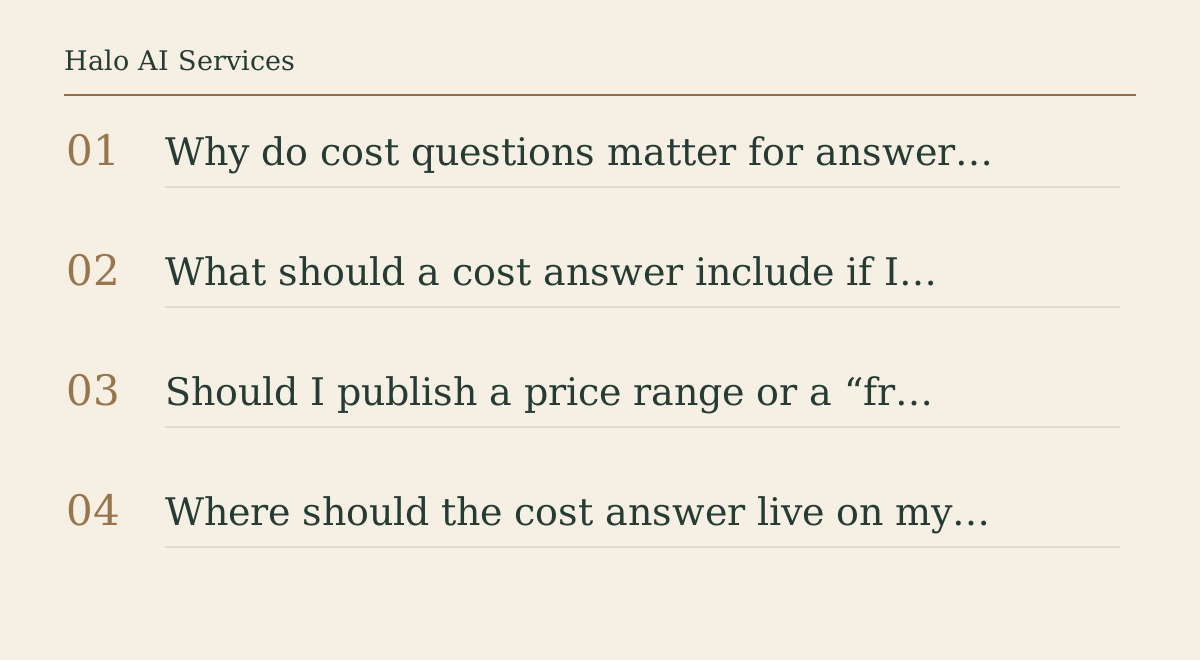
Why do cost questions matter for answer engines?
People ask assistants the questions they would feel awkward asking on the phone, and price is the obvious one. A business page that only says “contact us for a quote” answers a different question. It tells the reader how to get a price, not what affects one.
Google’s AI features guide says there are no extra requirements to appear in AI Overviews or AI Mode, and that the usual SEO best practices still apply. So the job is not a special format. It is a page that answers the question clearly in text a crawler can read. Whether ChatGPT search and Google’s AI features are allowed to reach that page at all is covered in the AI search citations guide.
None of this guarantees an assistant will quote your page. It removes a reason it cannot.
What should a cost answer include if I do not publish fixed prices?
Most trades and service firms price by the job, so a single number would be wrong more often than right. A useful cost answer can still say a lot:
- The direct answer in the first two sentences. For example: “Most of our [job] quotes depend on three things: X, Y and Z. We quote after [a visit, photos, a call].”
- What changes the price. Size, materials, access, urgency, location, and anything the customer can decide themselves.
- What is included and what is extra. Call-out, disposal, parts, VAT position, follow-up visits. Only list what is true for you.
- How the quote works. Free or paid, on site or remote, how long it usually takes you to reply, and whether it is fixed or an estimate.
- A starting figure or range, only if it is real. See the next section.
- The next step. One link or number, not five.
Halo’s iOS app development cost guide is one example of this pattern for a different kind of service: it explains what drives the cost rather than inventing a typical price.
Should I publish a price range or a “from” price?
Only if you would honour it. A range or “from” figure gives an assistant something concrete to quote, which is why it needs to stay accurate. Before publishing one, check:
- It comes from your own recent quotes or rates, not a competitor’s page or a national average you found online.
- You know what a job at the bottom of the range actually involves, and you say so.
- You know whether it includes VAT, and the page states it.
- Someone owns updating it, and the page shows when it was last checked.
UK traders should also know that price information shown to consumers is covered by consumer protection law. The Competition and Markets Authority’s unfair commercial practices guidance (CMA207) was updated in November 2025 to reflect its guidance on price transparency. Isle of Man firms should check the island’s own consumer rules. This guide is not legal advice. If you are unsure whether a figure is fair to publish, leave it out and explain what drives the price instead.
If you would rather show customers an indicative price from your own rates than write a range by hand, Halo builds instant-quote websites for trades that do exactly that, with each request sent to you.
Where should the cost answer live on my site?
Put it in one place you control and link to it from the others:
- A cost section on each service page, if your services price very differently. The service-page AEO guide covers the rest of that page’s structure.
- A single “pricing” or “how quotes work” page, if one explanation covers most of your work.
- Visible HTML text, not a PDF price list or an image of a rate card. If an old PDF still shows last year’s prices, update or remove it. The wrong business details guide explains how old pages like that end up in AI answers.
Avoid creating dozens of near-identical “cost of X in [town]” pages to catch every query. Write one good answer, then say which areas you cover.
Do my Google Business Profile and structured data need to match?
Yes. They should repeat what the page says, never add to it.
Google Business Profile lets you list services and, for some, add descriptions and prices. Google’s services help page also says custom service names should not contain prices, so put any figure in the price field, not the title. If your website gives a range and your profile shows a single old figure, you have created the kind of mismatch that is hard to trace later.
For structured data, Google’s structured data guidelines say not to mark up content that is not visible to readers. So any price in your markup must appear on the page in plain text. Google’s AI features guide also says no special schema is needed for its AI features. Add markup only if your site can keep it accurate.
What should I not do?
- Do not invent a “typical cost” or “average price” to give assistants something to quote.
- Do not copy a competitor’s range or a national figure and present it as yours.
- Do not hide a different price in structured data, a PDF or a profile field.
- Do not promise that publishing prices will get you cited, ranked or more enquiries. Nobody can promise that.
Where Halo fits
Halo’s search, AEO and content service covers service-page strategy, answer-first content and structured data. That can include drafting the cost section of a service page from rates you supply, then checking that the page and any markup say the same thing. If you publish figures, the proof ledger guide shows how to record where each one came from and when it was last checked. To start, send the service page you want reviewed through the free AI audit. Halo does not guarantee that any assistant will quote your page or your prices.
FAQ
Do I have to publish prices to appear in AI answers about cost?
No. A clear explanation of what affects the price, what is included and how quoting works is still a direct answer to the question. A real range or starting figure adds detail, but only publish one you would honour.
Will adding a price to structured data make Google show it in AI Overviews?
Google says no special markup is needed for AI Overviews or AI Mode, and that structured data must match what is visible on the page. Markup can describe a price you already show. It does not guarantee that price will be displayed.
Is it a problem if my website and Google Business Profile show different prices?
Yes. It gives search systems and customers two conflicting answers. Pick the accurate one, update the other, and record the date you changed it.
How often should I review a published price range?
Whenever your rates change, and on a schedule you set and can stick to. Show a “last checked” date on the page so readers and you can see how current it is.
Does FAQPage schema help my cost FAQ appear in Google?
Google now shows FAQ rich results only for well-known, authoritative government and health websites. FAQPage markup can still describe the questions on your page accurately, but it will not create a rich result for most businesses.
Sources
- Google Search Central, AI features and your website.
- Google Search Central, General structured data guidelines.
- Google Search Central, FAQ (FAQPage) structured data.
- Google Business Profile Help, Manage your services on your Business Profile.
- Competition and Markets Authority, Unfair commercial practices (CMA207).