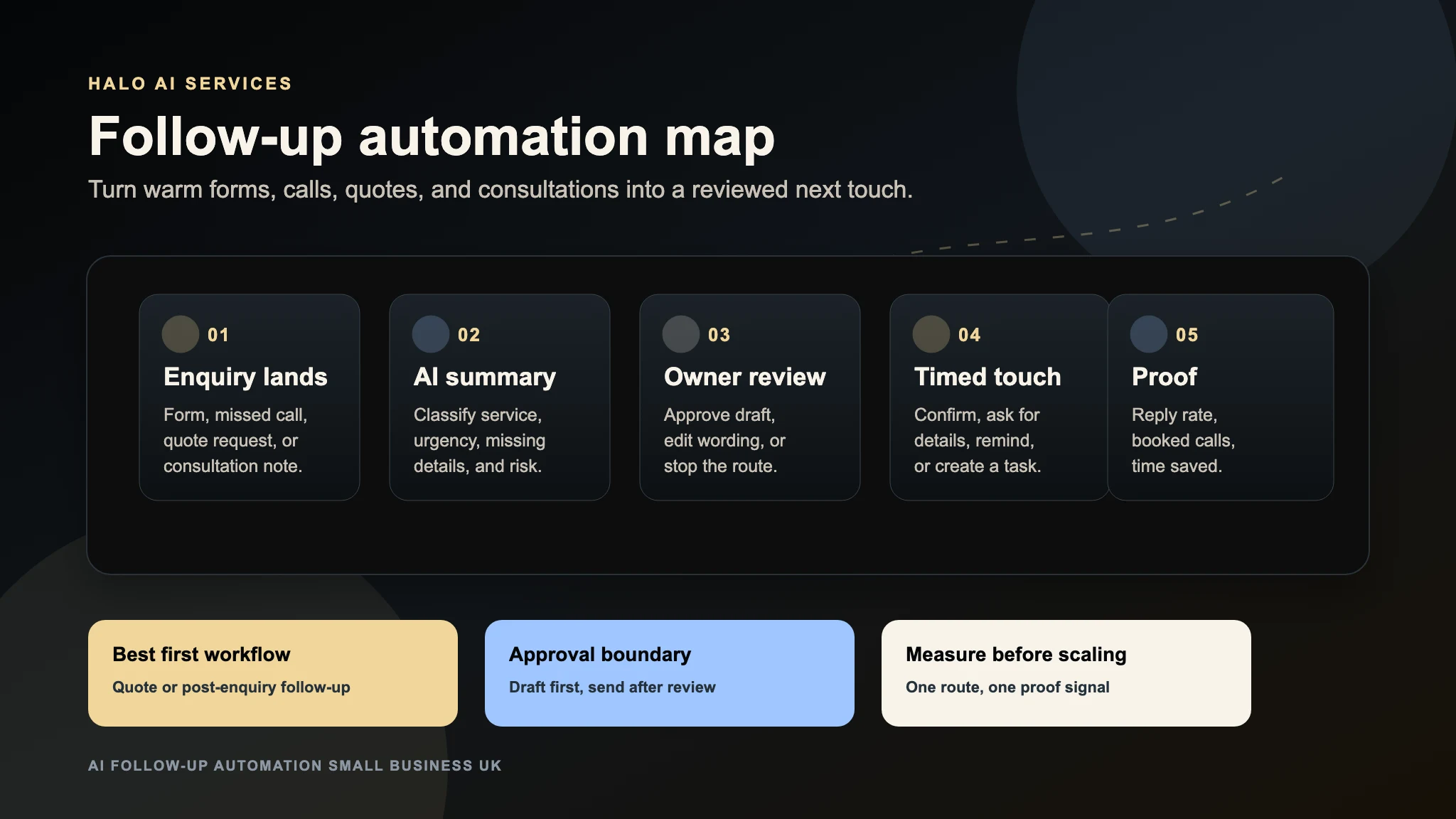
AI follow-up automation helps a small business respond after a form, call, quote request, consultation, or missed reply without relying on memory, spreadsheets, or the owner remembering to chase every enquiry manually.
The useful version is not a pushy sales sequence. It is a clear follow-up route that confirms the enquiry, fills missing details, reminds the right person, keeps the buyer warm, and shows whether the lead moved forward.
Quick Answer
For most UK SMEs, the best first AI follow-up automation is a post-enquiry or post-quote workflow with human review before anything sensitive is sent. Start with one route where leads already exist but go cold: a quote request, free consultation, missed call, booking enquiry, or proposal follow-up. The automation should summarise the lead, suggest the next step, send safe reminders only where approved, and measure response time, reply rate, booked calls, or accepted quotes.
Why Follow-Up Breaks
Small businesses rarely lose follow-up because nobody cares. They lose it because the work is scattered:
- Form submissions arrive in one inbox.
- Missed calls live in the phone log.
- Quote notes sit in a document or spreadsheet.
- The owner replies between jobs.
- Nobody knows which lead is urgent.
- The first reply happens, then the second touch never happens.
- Follow-up messages are rewritten from scratch every time.
AI can help when the business already knows the desired next action. If the next action is unclear, automation should start by creating a summary and task, not by sending messages on its own.
The Best First Follow-Up Workflow
Choose the first follow-up workflow using four filters:
- The buyer has already shown intent.
- The next step is predictable.
- The message can be written from safe, non-private context.
- A human can review or stop the workflow before risk increases.
Good first candidates include:
- Website form enquiry confirmation.
- Quote request missing-detail follow-up.
- Proposal sent but no reply after two working days.
- Missed-call summary and callback task.
- Consultation booked but no pre-call details supplied.
- Appointment reminder and post-appointment next step.
- Review request after completed work.
- Dormant warm lead check-in after a defined period.
Start with the route closest to revenue. A quote that never gets followed up is usually a better first target than a broad newsletter nurture sequence.
What AI Should Do
AI follow-up automation is strongest when it prepares, prioritises, and personalises within boundaries.
Useful jobs include:
- Summarising the enquiry in plain English.
- Classifying the lead by service type, urgency, location, or budget range.
- Drafting a reply for owner review.
- Asking for missing details with a short, specific question.
- Creating a follow-up task if no reply arrives.
- Sending a polite reminder only after the business approves the route.
- Updating a CRM, spreadsheet, or task list with status.
- Producing a weekly summary of open leads and stalled quotes.
The first sprint should not depend on a perfect CRM. It can begin with the tools the business already uses, as long as the trigger, output, and approval point are visible.
What Not To Automate First
Do not make the first follow-up automation responsible for:
- Final pricing decisions.
- Legal, medical, financial, HR, or safety advice.
- High-pressure sales messages.
- Customer complaints or disputes.
- Sending messages from private customer data the business has not approved for automation.
- Changing live records without a clear rollback path.
- Multi-step campaigns where nobody can explain the current follow-up process.
If the workflow touches risk, automate the preparation first. For example, create the summary, suggested reply, and task, but keep the owner in control of the send.
A Simple Follow-Up Map
Use this implementation map before buying tools:
- Trigger: what starts the workflow?
- Source: where does the enquiry or quote live now?
- Context: what fields are safe and useful?
- First action: confirm, ask, summarise, task, or remind?
- Approval: does a human review before send?
- Timing: when should the next touch happen?
- Stop rule: what stops the follow-up?
- Proof: what signal shows the workflow helped?
This stops follow-up automation becoming a vague AI assistant project. It turns the first build into a route that can be checked.
Message Timing
Timing should match buyer intent and business risk.
For a high-intent enquiry, the first useful action is usually immediate acknowledgement and internal prioritisation. The buyer should know the request arrived, and the business should know what to do next.
For a quote or proposal, the first reminder should be polite and useful, not desperate. A common route is:
- Same day: confirmation or summary.
- Next working day: missing details or booking link if needed.
- Two to three working days later: check whether they need anything else.
- One week later: final helpful follow-up or close-the-loop note.
That sequence is only a starting point. The business should adjust timing by service value, urgency, sales cycle, and customer expectation.
Proof Signals
The first follow-up workflow should prove one measurable thing.
Useful proof signals include:
- Faster first response.
- Fewer unassigned enquiries.
- More quote replies.
- More booked consultations.
- Fewer leads waiting without a next task.
- Less owner time spent rewriting follow-up messages.
- Cleaner CRM or spreadsheet status.
Avoid judging the first sprint by vague claims like better engagement. Pick the before-and-after signal before the automation is built.
What To Send Halo For An Audit
For a useful free audit, send one follow-up route rather than a broad automation wishlist.
Good inputs are:
- The page, form, missed-call path, or quote process where leads arrive.
- The current follow-up steps.
- The point where leads go cold.
- The message or task that should happen next.
- The approval boundary: review-only, draft-ready, or send-after-proof.
- The proof signal that would make the fix worth expanding.
Halo can then map the smallest useful follow-up slice: capture the context, summarise the lead, create the next task, draft the reply, or add a safe reminder route.
FAQ
What is AI follow-up automation?
AI follow-up automation uses AI and workflow rules to help a business respond after an enquiry, call, quote, booking, or proposal. It can summarise the lead, draft replies, ask for missing details, create tasks, send approved reminders, and track whether the opportunity moved forward.
Should a small business automate follow-up before lead generation?
If warm leads already go cold, yes. A business should fix follow-up before buying more traffic because every new lead will still enter the same weak response path. If there are not enough enquiries yet, improve visibility and lead capture first.
Can AI send follow-up emails automatically?
It can, but the safer first version usually drafts messages or sends only tightly approved reminders. Human review is important for pricing, complaints, sensitive sectors, unusual requests, and any message that could affect trust.
What is the best first follow-up automation for a UK SME?
The best first workflow is usually quote follow-up, missed-call callback routing, consultation pre-call detail collection, or post-enquiry missing-detail follow-up. Choose the route with existing buyer intent, predictable next steps, and a measurable outcome.
How do you measure follow-up automation ROI?
Measure the before-and-after signal closest to revenue: response time, reply rate, booked calls, quote acceptance, unassigned leads, or owner time saved. The first workflow should prove one signal before expanding into a wider sales automation system.