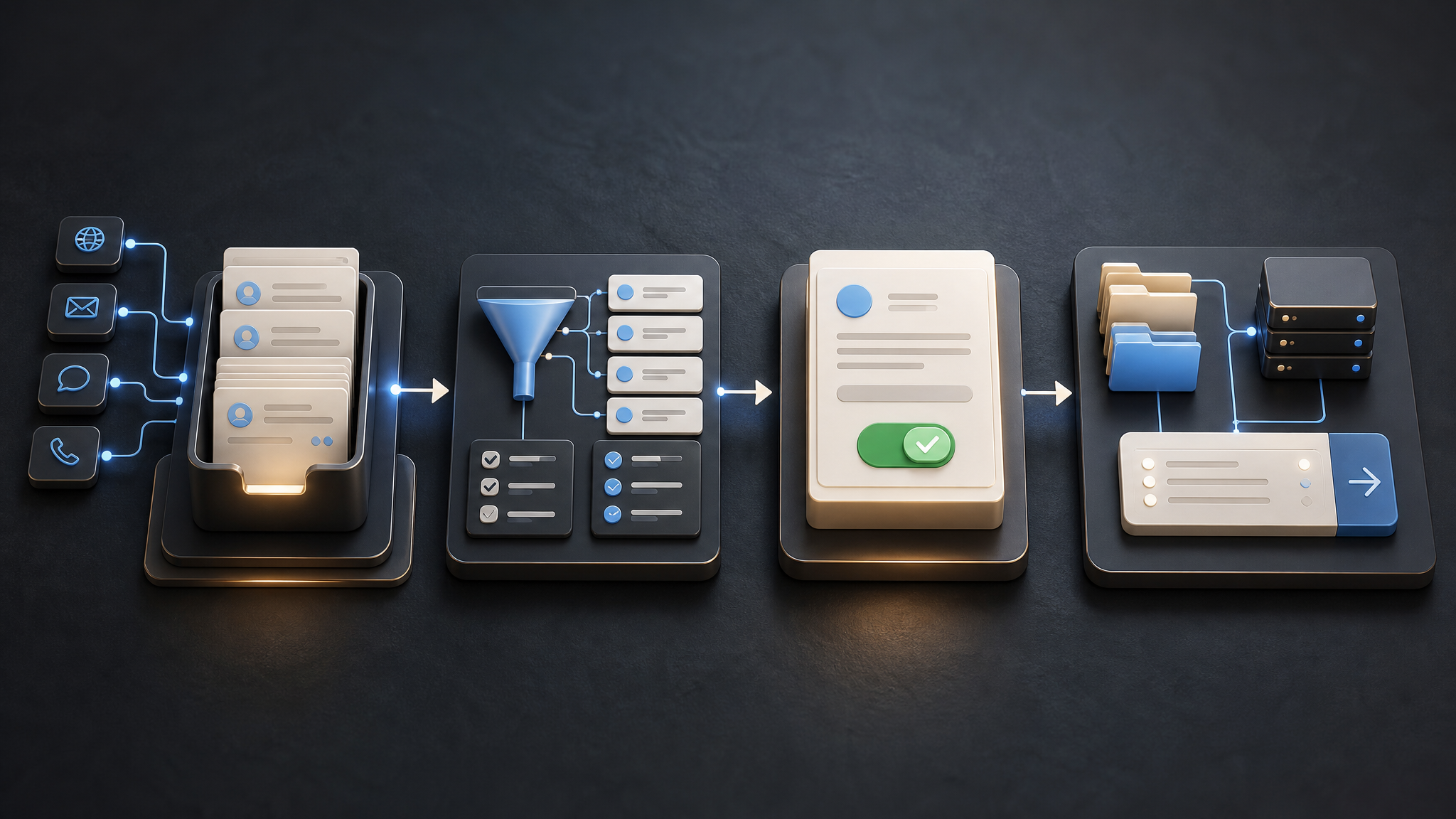
AI automation is most useful for small businesses when it removes a repeated bottleneck close to revenue: missed enquiries, slow follow-up, manual qualification, copied spreadsheet work, or admin handoffs that delay the next action.
The mistake is starting with a broad automation platform before the workflow is understood. The better first move is to choose one repeatable process, define the approval boundary, ship a small version, and measure whether it saves time or captures more value.
Quick Answer
For most UK SMEs, the first AI automation workflow should be a lead or admin handoff that happens often, follows clear rules, and has a measurable outcome. Good first candidates include missed-call capture, enquiry qualification, quote-request summaries, appointment follow-up, inbox triage, review requests, CRM updates, and recurring report preparation. Avoid automating judgement-heavy, sensitive, or rarely repeated work until the safer workflow has proved value.
The First-Workflow Rule
Choose the first workflow using three filters:
- It happens every week.
- It has a clear trigger and output.
- A human can review or override the result before it affects customers, money, or records.
That rule keeps the first sprint practical. A business does not need an AI transformation programme to prove whether automation helps. It needs one workflow that is boring enough to repeat and important enough to measure.
Best First AI Automation Use Cases
Strong first automations for small businesses usually sit in the gap between a buyer action and the next team action:
- Website enquiry summary sent to the right inbox with urgency and service type.
- Missed-call capture followed by a qualification text, email, or task.
- Quote-request intake that asks for missing details before the owner replies.
- Appointment reminder and follow-up route.
- Inbox triage for common enquiry types.
- Review-request sequence after completed work.
- CRM or spreadsheet update after a form, call, or email.
- Weekly lead, task, or pipeline summary.
These work because they are repeatable and visible. The business can compare the old route with the automated route.
What Not To Automate First
Avoid making the first automation responsible for:
- Legal, medical, financial, safety, or HR decisions.
- High-value pricing decisions without review.
- Customer complaints that need empathy or judgement.
- Processes with no written rule or owner.
- Rare tasks that do not justify setup time.
- Multi-system changes where nobody can explain the current workflow.
If a task is risky, automate the preparation rather than the decision. For example, summarise the enquiry and suggest the next task, but keep human approval before sending a final quote or changing a customer record.
The Cost Question
Small business AI automation costs vary by scope, but the useful buying question is not just monthly software cost. Ask what the first workflow must prove.
Typical first-sprint cost drivers include:
- How many systems are involved.
- Whether the workflow is customer-facing.
- Whether human approval is needed.
- How clean the existing forms, inboxes, spreadsheets, or CRM data are.
- How many exceptions need handling.
- Whether testing needs call, form, email, or booking scenarios.
For a narrow first workflow, a practical implementation should usually define the trigger, rules, handoff, failure state, owner approval point, and proof signal before a larger retainer or platform rollout is discussed.
A Practical Scoring Method
Score each candidate workflow from 1 to 5:
- Frequency: does it happen often enough to matter?
- Revenue proximity: does it affect enquiries, bookings, quotes, or paid work?
- Rule clarity: can the team explain what should happen next?
- Risk level: can a human review before anything sensitive changes?
- Measurement: can you compare time saved, response speed, capture rate, or completed handoffs?
Pick the workflow with the highest total score and the lowest unresolved risk. If two options are close, choose the one closest to the buyer path.
Example: From Enquiry to Admin Handoff
A local service business receives website enquiries, missed calls, and occasional Facebook messages. The owner manually reads each one, asks follow-up questions, adds details to a spreadsheet, and replies when there is time.
A sensible first automation would not replace the owner. It would:
- Capture the enquiry source and contact details.
- Classify the service type and urgency.
- Ask for one or two missing details if needed.
- Send a summary to the owner.
- Create the follow-up task or spreadsheet row.
- Mark anything uncertain for human review.
That is enough to test whether response speed improves and admin time falls without handing the whole customer relationship to automation.
Approval Boundaries
Before launch, write down what the automation can and cannot do.
It can usually:
- Summarise an enquiry.
- Ask low-risk follow-up questions.
- Route a task.
- Draft a reply for review.
- Update a non-sensitive tracking sheet.
- Notify the owner when action is needed.
It should not do without explicit approval:
- Publish website changes.
- Send sensitive or high-stakes messages.
- Change prices, contracts, or customer commitments.
- Access private customer records unnecessarily.
- Connect new tools or accounts without review.
- Continue silently when an error or uncertainty appears.
This protects the business and makes the first workflow easier to approve.
AEO-Friendly Buyer Questions
A useful AI automation page should answer the questions buyers actually ask:
- What can AI automate in a small business?
- Which workflow should I automate first?
- How much does business automation cost in the UK?
- Can AI handle enquiries and follow-up?
- What are the risks of AI automation?
- Do I need CRM integration first?
- How do I measure whether automation worked?
- What should stay human?
Those answers also help search engines, answer engines, and AI assistants understand the service clearly.
FAQ
What is the best first AI automation for a small business?
The best first AI automation is usually a repeated enquiry, follow-up, or admin handoff that has clear rules and a measurable outcome. Missed-call capture, enquiry qualification, quote-request summaries, and inbox triage are common first candidates.
How much does AI automation cost for a small business in the UK?
Costs depend on workflow complexity, systems involved, review requirements, and support needs. A narrow first sprint should define the trigger, rules, handoff, approval boundary, and proof signal before a broader monthly automation setup is recommended.
Can AI automation replace staff?
For most SMEs, the safer goal is not replacing staff. It is reducing repeated admin, speeding up response, and making sure good enquiries are captured and routed. Human review should stay in place for sensitive, high-value, or judgement-heavy work.
What should not be automated first?
Do not start with legal, financial, medical, HR, safety, complaint, or high-value pricing decisions. If the workflow carries risk, automate the summary, preparation, or task creation first and keep the final decision human.
Next Step
List three workflows that waste time or slow enquiries. Score each one for frequency, revenue proximity, rule clarity, risk, and measurement. Send the strongest candidate through the free AI audit so Halo can map the smallest useful automation slice before a bigger build.