Answer first: An AI receptionist, for a small firm, is a scripted way to answer an inbound call you are already missing, write down enough for a person to act, and hand the awkward calls to a human. It is not an outbound marketing dialler, and it is not a reason to invent how many jobs you will win. Cost and payback belong in Halo's separate AI receptionist ROI guide. This article does not add a recovery rate, a price, or a customer result.
Quick answer
Use it on the number printed on the van, the site, and the listing. The caller should hear the business name, that they are talking to an automated assistant, and what will happen next, but only if that next step is true. Capture the job in their words, the area, how urgent it is, a name, and a number that works. Do not capture card details. Do not let the assistant quote a price you have not worked out. If you later text offers or ring people who did not call you, UK PECR and the Isle of Man Unsolicited Communications Regulations start to matter. Answering someone who rang you is a different activity.
This is not legal advice. UK firms should read the ICO's current pages. Isle of Man firms should read the Information Commissioner's current pages. Rules and guidance change, and the right answer depends on what the system actually does.
What this is, and what it is not
Someone rings because the homepage, a directory, or a sign told them to. Nobody picks up. A system speaks, asks a few questions, and sends the owner a note. That is missed-call lead capture.
It is not any of these:
- A recorded marketing message played to a list of numbers. In the UK, the ICO's telephone marketing guidance says an automated marketing call needs specific consent for that type of call from you. General marketing consent, or consent for live calls, is not enough. The rule sits in PECR regulation 19. The regulation describes a system that can automatically start a sequence of calls to more than one destination and play sounds that are not live speech.
- The Isle of Man equivalent for that outbound pattern is regulation 2 of the Unsolicited Communications Regulations 2005. The Information Commissioner explains the regulations, including automated calling systems, on inforights.im. The Commissioner's office is the supervisor for those regulations and for the Island's data protection law: P.O. Box 69, Douglas, IM99 1EQ, +44 1624 693260, [email protected].
- A silent or abandoned outbound call. Ofcom's note on silent and abandoned calls is about misuse of networks when diallers and call handling leave people with silence or a dropped call. Read it before anyone turns on outbound dialling. An inbound "we missed you" assistant should not sit in silence either.
A live person who rings back a caller, because that caller just asked for a call, is ordinary follow-up. A system that starts working through a bought list is marketing. Keep those buttons separate. If the vendor's product does both, know which one you have switched on.
The route, using a labelled example
This is a worked example, not a Halo job and not a result. A joiner is on a roof. The mobile rings. He cannot take it. The assistant answers.
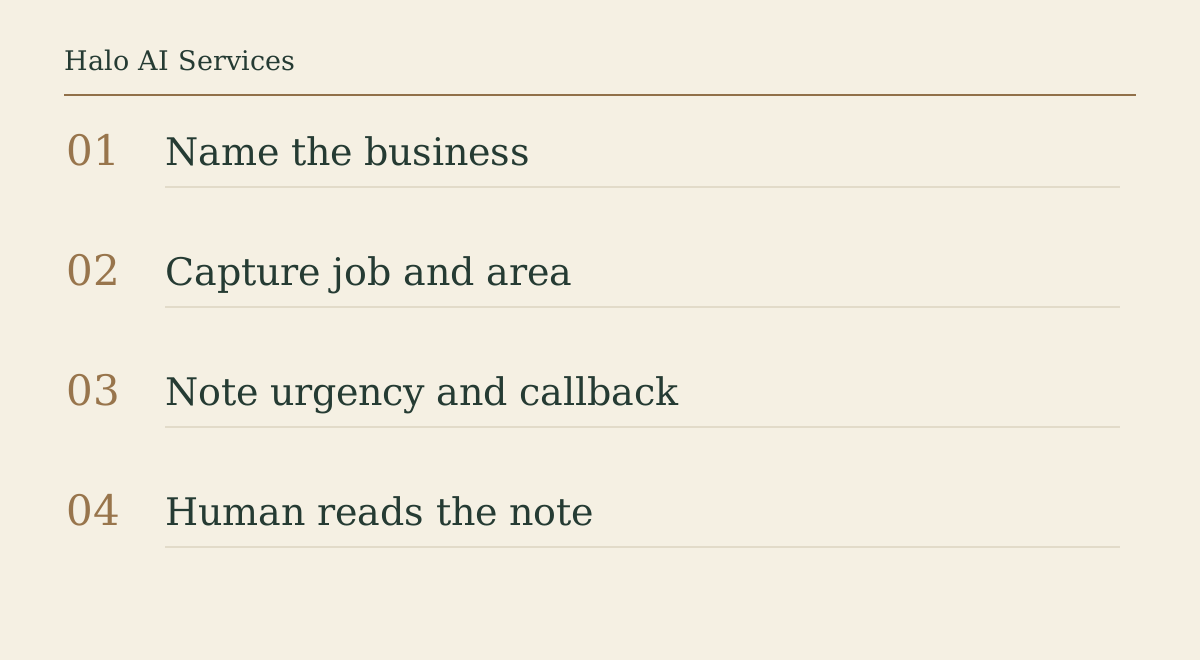
- It says the trading name, that this is an automated assistant, and that a person will read the note.
- It asks what the caller needs, in one or two sentences.
- It asks where the job is. The script only offers areas the joiner actually covers. It does not say "anywhere in the UK".
- It asks whether someone is at risk right now, water is coming through a ceiling, or the job can wait for a normal callback. Safety wording should point people at the emergency services when that is the real answer, not at a chatbot troubleshooting electrics.
- It asks for a name and a callback number, and reads the number back.
- It does not give a price, a same-day promise, or a completion date.
- It sends a short note to the joiner by the channel he actually reads during the day.
- He decides who to ring back, and the follow-up route takes over from a real note, not from a guessed lead score.
If the caller asks for a person and nobody is available, the assistant should say that plainly and take the message. Pretending a human is "just checking the diary" is how these systems lose trust in one call.
What to write down
Keep the first script short enough that a caller on a noisy street will finish it.
Capture:
- Trading name they thought they were calling, if you answer more than one brand.
- What they want, in their words, not a code you forced them to pick.
- Town, district, or postcode. "The Island" is not enough if you only work in the south.
- Urgency, using categories you defined. Do not let the model invent a priority scale.
- Name and callback number.
- Time of the call and the number they rang.
- Whether they asked for a person.
- If you will ring them back later, the fact they asked you to. That is different from consent to a newsletter.
Leave out of the first script:
- Card numbers, bank details, and passwords.
- Medical history, anything about a child's welfare, or a neighbour's dispute. Take a message and stop.
- A quote. If the price depends on seeing the job, the note should say that a visit or a photo is needed.
- A long survey. Every extra question drops people who only rang to ask if you cover Ramsey.
Store the note where the owner already looks. A second inbox that nobody opens is a missed call with extra steps. The website form should ask the same core questions, so phone and web land in one queue. Halo's lead-capture guide is the form side of that queue. Do not run a page chatbot and a phone assistant that disagree about what you do.
What the caller should hear
Say the business name first. Say that the voice is an automated assistant. Say what a person will do next, and only promise a time you can keep. "Someone will call you back in five minutes" is a lie if you are driving until six.
If the matter is urgent and you have a real escalation number, give it. If you do not, say you do not, and do not invent a duty manager.
If you record the call or store a transcript, say so at the start and say why. On the ICO's call-monitoring guidance, which covers both workers and the people who call an organisation, you must tell callers that you are recording and why. A recorded message is described as good practice, with the rest of the privacy information available another way, such as a page on the site. The same guidance says recording the content of every call is not usually proportionate when a narrower record would do. A transcript of a sales enquiry is still personal data. Decide the purpose before you switch recording on, and put the purpose in the privacy notice.
That ICO page is UK guidance. It does not automatically govern an Isle of Man controller. Island firms should use the Isle of Man Information Commissioner and the Island's data protection legislation. The practical point is the same shape: a recording or a transcript is personal data, so you need a reason you can explain, a notice at the start of the call, and a privacy page that matches what the assistant does. Do not stamp the product "GDPR ready" and skip that page.
When a person has to take over
Hand over, or take a message and stop the script, when:
- The caller asks for a human.
- The assistant has misunderstood twice.
- The call is a complaint, a refund, or an accusation.
- Someone may be unsafe, or the job is gas, fire, flooding into electrics, or a similar emergency.
- The caller is describing a health problem, a legal dispute, or someone else's personal life.
- The only honest next step is a site visit or a written quote you have not prepared.
- The caller is silent. Do not fill the silence with a guessed booking.
Best-fit trades and clinics are discussed as categories in the ROI guide, which also says healthcare, legal, financial, emergency, safeguarding, and complaint routes need specialist review. This article does not soften that. A dentist's missed-call line and a joiner's missed-call line are not the same script.
The marketing line after the call
A confirmation text that says "We have your message and will ring this number" is part of answering the call they made. A text that adds a discount, a newsletter, or a brother's roofing firm is marketing.
For UK electronic mail, including SMS, PECR has its own rules. The ICO's telephone-marketing pages are the phone half; do not assume a phone consent covers email. For the Isle of Man, regulation 5 of the Unsolicited Communications Regulations 2005 covers unsolicited direct-marketing electronic mail to individual subscribers. Consent is the default. A narrow exception exists where the details were collected during a sale or negotiation for a sale, the message is only about that sender's similar products, and a simple refusal was offered when the details were collected and on later messages. A missed call is not, by itself, that sale. If you are unsure, send the callback confirmation only.
Regulation 6 of the same Island regulations says marketing electronic mail must not disguise who sent it, and must include a valid address people can use to tell you to stop. The UK rules are the same idea. Put the trading name in the text.
Live unsolicited marketing calls have a further set of rules: objections, and the telephone preference registers. The ICO explains the UK position, including TPS and CTPS. The Island Information Commissioner's guide to the regulations says the registers of people who do not want unsolicited telephone or fax marketing are the Telephone Preference Service and the Fax Preference Service. None of that is a reason to avoid ringing back a person who just asked you to ring them about their own job. It is a reason not to reuse their number for a campaign.
People in the UK have a data-protection right to object to direct marketing. The ICO's guide to live marketing calls says that if someone objects, you stop using their data for that purpose. Build the "do not ring me again" outcome into the note. A spreadsheet with no suppression list will eventually call the person who already said no.
Halo's AI policy template is the place to write which tool is approved, what it may store, and who reviews a bad transcript. The receptionist vendor's standard contract does not replace that page.
What to test before a long contract
Use your own recent missed calls. Write five to ten of them down from the phone you already have: wrong number, "are you still trading", a real job, a complaint, an emergency. Do not invent a monthly volume to impress yourself.
Then run those calls at the script, or read the transcripts if the vendor will do test calls with you on the line.
Keep four counts, and only those:
- Notes a person could act on without ringing back to ask the same question.
- Calls the assistant should have stopped or handed over, and whether it did.
- Promises it made that are not true (price, area, arrival time, a named staff member who does not exist).
- Callers who would have had no idea they were talking to software.
Stop the pilot if the third count is not zero. A fluent assistant that invents a price is worse than voicemail.
The ROI guide shows how to compare cost with a contribution margin, and it labels its arithmetic as an illustration, not a Halo or customer result. Use that guide if you need a money model. Do not paste its illustration into a proposal as if it were your numbers. This article adds none.
What not to claim
- That every missed call was a lost job, or that any share of them will come back.
- A payback period, a percentage, or a "clients saved X hours" line. There is no client result in this article.
- That the assistant is an employee, a regulated adviser, or a substitute for emergency services.
- That "GDPR ready" on a pricing page settles PECR, the Island's Unsolicited Communications Regulations, or your privacy notice.
- A same-day callback, Island-wide cover, or a 24-hour desk unless that is actually how you work.
Where Halo fits
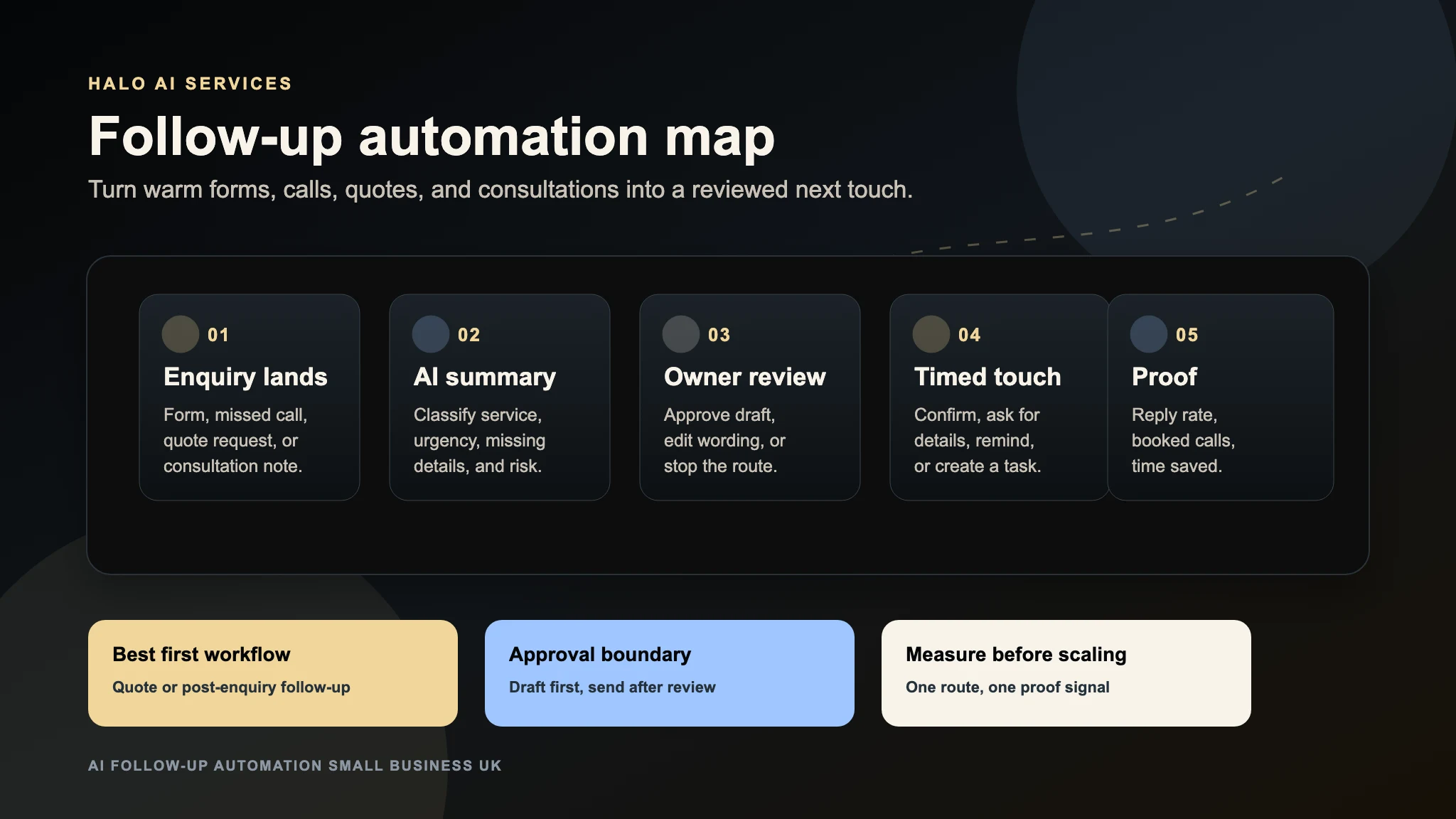
AI receptionists and lead response is the related service: qualification and human escalation stay visible. If you already have a number, a rough script, and a week of missed calls you are willing to describe, the free audit is the first look. Send the current route. Do not send a hope that the phone will "pay for itself".
FAQ
Is an AI receptionist the same as an automated marketing call?
No. Answering one inbound call from someone who rang your published number is not the same activity as a system that automatically calls many destinations and plays a recorded marketing message. PECR regulation 19 requires specific consent for that UK marketing pattern. Regulation 2 of the Isle of Man Unsolicited Communications Regulations 2005 requires the subscriber to have consented to those recorded marketing communications. Check the product, because some platforms do both.
What should the first version capture?
The job in the caller's words, the area, the urgency, their name, a callback number, and the time. Leave out payment details and any quote you have not calculated. Match those fields to the website form so you are not running two different definitions of an enquiry.
Do I have to tell people the voice is automated?
Yes, if you want the call to be honest, and yes if you are recording. The ICO expects callers to be told when a call is recorded and why. Even without a recording, a caller who thinks they have reached a person in the van has been misled if they have not. Say it in the first sentence.
Can I text a discount after the missed call?
Treat that as marketing, not as part of taking the message. UK PECR and, on the Island, the Unsolicited Communications Regulations put consent rules around unsolicited marketing by electronic mail, which includes SMS. A missed call is not automatically a sale. A short "we have the message and will call this number" text is the safer first version. This is not legal advice.
Does this replace voicemail?
It can, if the note is better than a garbled voicemail and a person still reads it. If nobody reads the note, you have bought a second voicemail. Test that on your real missed calls before you sign a long contract.
Where are the costs and the payback maths?
In the AI receptionist ROI guide. That guide's figures are labelled as an illustration, not a customer outcome. This article does not repeat them and does not supply new ones.
Sources
- ICO, telephone marketing and automated calls.
- ICO, what else to consider on live marketing calls, including the right to object to direct marketing.
- ICO, call monitoring and telling callers.
- UK legislation, PECR regulation 19 (automated calling systems).
- Isle of Man Information Commissioner, Unsolicited Communications Regulations.
- Isle of Man legislation, Unsolicited Communications Regulations 2005 (regulations 2, 5, and 6 as relevant to automated calls and electronic mail).
- Isle of Man Government, Information Commissioner.
- Ofcom, silent and abandoned calls.